
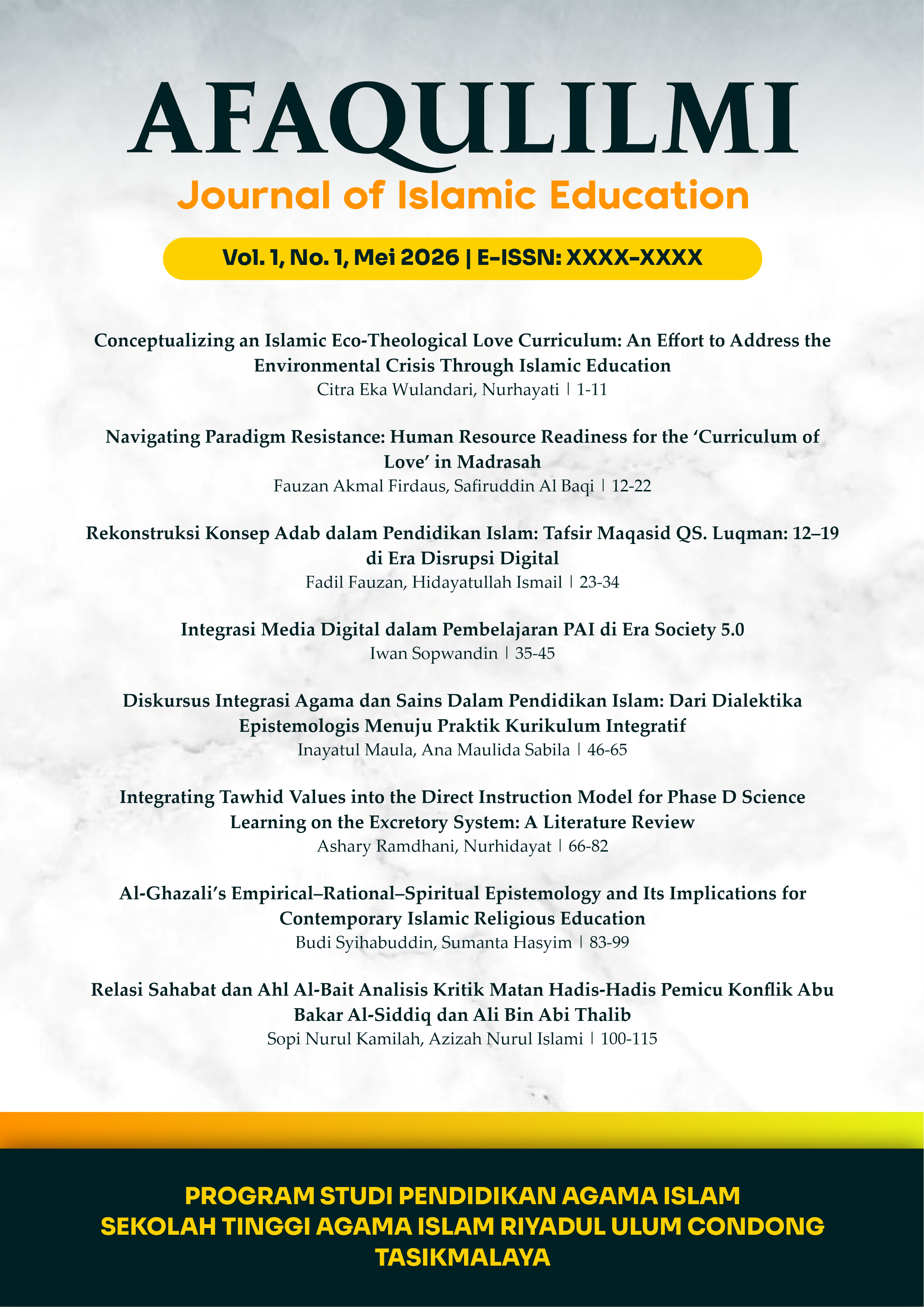
Relasi Sahabat dan Ahl Al-Bait Analisis Kritik Matan Hadis-Hadis Pemicu Konflik Abu Bakar Al-Siddiq dan Ali Bin Abi Thalib
Keywords:
Hadits, Sejarah, Konflik Abu Bakar al-SiddiqAbstract
Penelitian ini menunjukan bahwa hadis-hadis yang menjadi pemicu konflik antar Abu Bakr al-Shidiq dan keluarga Ali bin Abi Thalib belum diteliti secara mendetail oleh para sejarawan, maka dari itu peneliti a-kan melakukan analisis terhadap hadis-hadis tersebut dengan menggunakan metodologi penelitian sanad dan matan. Selain daripada itu, peneliti akan melakukan pemaparan asbab al-wurud hadis-hadis tersebut. Agar para pembaca sejarah tidak lagi salah paham atas Abu Bakr al-Shidq yang dalam catatan sejarah tidak akur dengan keluarga Ali bin Abi Thalib. Hadis-hadis yang menjadi pemicu terjadinya konflik antar keduanya sampai saat ini dimanfaatkan oleh golongan yang mengagungkan Ali bin Abi Thalib dan mengecilkan sahabat yang lain terutama Abu Bakr al-Shidq. Penelitian ini menggunakan sebuah pendekatan sebagai sebuah sudut pandang (starting view) bagaimana suatu permasalahan tersebut didekati, dibahas dan dianalisa. Untuk itu pendekatan yang digunakan dalam penelitian ini adalah pendekatan sejarah (historical approach). Seperti yang diungkapkan oleh Nabia Abbot tentang kesamaan hadis dan sejarah, maka sebagai konsekuensinya, sejarah pun harus didekati melalui pendekatan hadis. Metode yang digunakan dalam penelitian ini adalah metode kualitatif normatif yaitu telaah untuk memecahkan suatu masalah yang pada dasarnya bertumpu pada penelaahan kritis dan mendalam terhadap bahan-bahan pustaka yang relevan.
References
al-Amini, A. a.-H. (1997). Al-Ghadīr fī al-Kitāb wa al-Sunnah wa al-Adab, Juz 1. Teheran: Dār al-Kutub al-Islamiyyah.
al-Asqalani, I. H. (1960). Fatḥ al-Bārī Syarḥ Ṣaḥīḥ al-Bukhārī, Juz 8. Beirut: Dār al-Ma‘rifah.
Al-Hajjaj, bin Muslim. (1998). Shahih Muslim. Beirut: Dar al-Hadist.
al-Jurjani, A. a.-Q. (2004). Dalā’il al-I‘jāz. Beirut: Dar al-Kutub al-'Ilmiyyah.
Al-Thabari. (1883). Tarikh al-Rusul wa Al-muluk. Leiden: Brill.
al-Naysaburi, a.-H. (1990). Al-Mustadrak ‘ala al-Shahihayn. Beirut: Dar al-Kutub al-'Ilmiyah.
Al-Qazwiny. (2003). Sunan Ibn Majah. Beirut: Dar Al-Fikr.
Al-Syirazi, A. S. (2008). Madzlumiyat Al-Zahra. Beirut: Munadzomah Alamiyah.
al-Tabataba'i, M. H. (1997). Al-Mīzān fī Tafsīr al-Qur'ān. Qom, Iran: Mu’assasah al-A‘lami.
Azra, A. (2002). Historiografi Islam Kontemporer: Wacana, Aktualisasi dan Aktor Sejarah. Jakarta: Gramedia.
Hanbal, A. b. (2003). Al Musnad. In Al-Baihaqy, Sunan Al-Kubro (p. 409). Beirut: Dar Al-Kutub Al-Ilmiyah.
Hanbal, A. I. (1969). Musnad al-Imam Ahmad ibn Hanbal, Juz 4. Beirut: Dar Sadir.
Hasan, A. (1963). Al-Naḥw al-Wāfī, Juz 1 halaman 489. Kairo: Dār al-Ma‘ārif.
Hassan, T. (2006). Maqālāt fī al-Lugah wa al-Adab. Kairo: 'Ālam al-Kutub.
Kathir, I. (1986). Al-Bidāyah wa al-Nihāyah. Beirut: Dar al-Fikr.
Kathir, I. (1999). Tafsīr al-Qur'ān al-'Aẓīm. Beirut: Dār Ṭayyibah.
Madelung, Wilferd. (1997). The Succession to Muhammad. Inggris: Cambridge University Press.
M.Khamis, U. (2008). Hiqbah min aal-Tarikh. Mesir: Maktabah Al-Huda.
Mahsun. (2007). Metode Penelitian Bahasa: Tahapan Strategi, Metode, dan Tekniknya. Jakarta: Raja Grafindo Persada.
Manzur, I. (1994). Lisān al-‘Arab. Beirut: Dar Sadir.
Ruslan, R. (2004). Metode Penelitian: Public Relation and Communication. Jakarta: PT. Raja Grafindo Persada.
Sibal, M. (2012). Al-Sunnah wa Makanatuha fi al-tasyri al-Islam. Kairo: Dar as-Salam.
Taimiyah, I. (1986). Minhaj al-Sunnah. Riyadh, Arab Saudi: Jami'ah al-Imam Muhammad bin Saud al-Islamiyah.
Downloads
Published
Issue
Section
License
Copyright (c) 2026 Sopi Nurul Kamilah, Azizah Nurul Islami (Author)

This work is licensed under a Creative Commons Attribution-ShareAlike 4.0 International License.

This work is licensed under a Creative Commons Attribution-ShareAlike 4.0 International License.
You are free to:
- Share — copy and redistribute the material in any medium or format for any purpose, even commercially.
- Adapt — remix, transform, and build upon the material for any purpose, even commercially.
- The licensor cannot revoke these freedoms as long as you follow the license terms.
Under the following terms:
- Attribution — You must give appropriate credit , provide a link to the license, and indicate if changes were made . You may do so in any reasonable manner, but not in any way that suggests the licensor endorses you or your use.
- ShareAlike — If you remix, transform, or build upon the material, you must distribute your contributions under the same license as the original.
- No additional restrictions — You may not apply legal terms or technological measures that legally restrict others from doing anything the license permits.
Notices:
You do not have to comply with the license for elements of the material in the public domain or where your use is permitted by an applicable exception or limitation .
No warranties are given. The license may not give you all of the permissions necessary for your intended use. For example, other rights such as publicity, privacy, or moral rights may limit how you use the material.


