
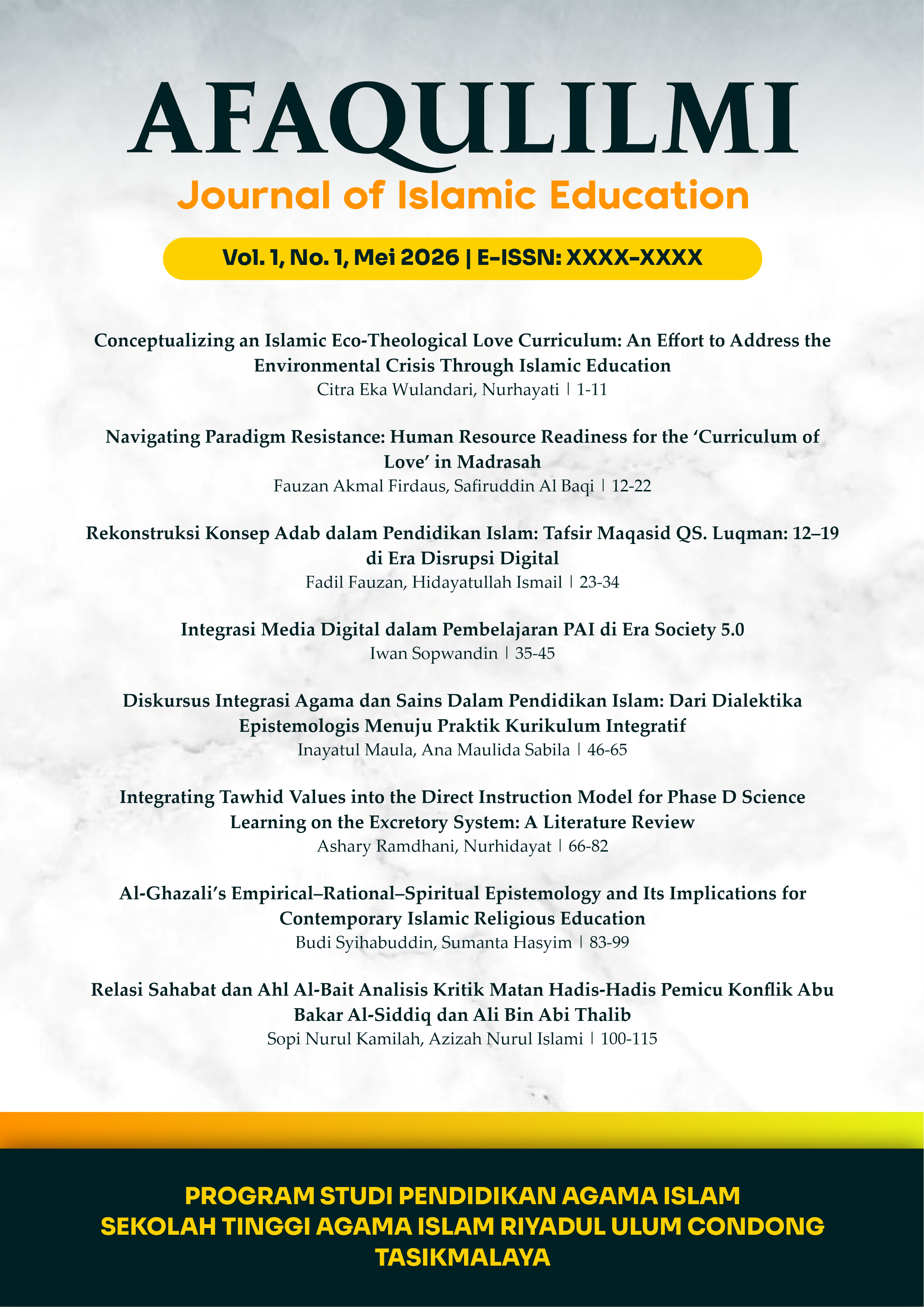
Diskursus Integrasi Agama dan Sains Dalam Pendidikan Islam: Dari Dialektika Epistemologis Menuju Praktik Kurikulum Integratif
Keywords:
Integrasi Agama dan Sains, Dialektika Epistemologis, Kurikulum Integratif, PAIAbstract
Penelitian ini bertujuan menggali dasar pemikiran (raison d’etre) gagasan integrasi agama dan sains, dialektika epistemologis para eksponen utamanya, hingga implementasi praktisnya dalam pembelajaran Pendidikan Agama Islam (PAI). Metode penelitian yang digunakan adalah pendekatan kualitatif dengan jenis penelitian kepustakaan (library research), di mana sumber data berbentuk dokumen tertulis yang dianalisis menggunakan teknik analisis isi (content analysis). Hasil penelitian menunjukkan: 1) Raison d’etre gagasan integrasi agama dan sains merupakan diskursus yang lahir sebagai upaya untuk mengejar ketertinggalan dunia Islam sekaligus ‘mengembalikan’ posisi Tuhan dalam wacana sains modern. 2) Dialektika epistemologis schools of thought integrasi agama dan sains merupakan perdebatan panjang antara para pendukung sains Islam, dengan beberapa modelnya, yang mengklaim sains modern tidak bebas nilai. Gagasan ini menuai kritik dari kalangan instrumentalis dengan klaimnya objektivitas dan netralitas sains. 3) Implikasi praktisnya adalah penerapan kurikulum integratif PAI yang dapat didasarkan pada sepuluh model kurikulum integratif Fogarty yang meliputi model fragmented, connected, nested, sequenced, shared, webbed, threaded, integrated, immersed, dan networked.
References
Adu, L., Rama, B., & Yahdi, M. (2023). Islamisasi Ilmu Pengetahuan. Jurnal Studi Islam Lintas Negara, 5(1), 21–33.
Al-Attas, S. M. N. (1979). Aims And Objectives Of Islamic Education. King Abdulaziz University.
Al-Attas, S. M. N. (1993). Islam and Secularism. International Institute of Islamic Thought and Civilization (ISTAC).
Al-Attas, S. M. N. (1999). The Concept of Education in Islam: A Framework for An Islamic Philosophy of Education. International Institute of Islamic Thought and Civilization (ISTAC).
Al-Faruqi, I. R. (1989). Islamization of Knowledge: General Principles and Work Plan. International Institut of Islamic Thought (IIIT).
Ali, J. A. (2023). Modernity, Its Crisis and Islamic Revivalism. Religions , 14(1). https://doi.org/10.3390/REL14010015
Al-Najjar, Z. R. M. (2005). Min Ayat Al-I’jaz Al-’Ilmi-Al-’Ardhi fi al-Qur’an Al-Karim. Dar El-Mareefah.
Bahri, A. H. (2022). Characteristic and Attributes of the Modernization of Islam in Egypt. Pappaseng: International Journal of Islamic Literacy and Society, 1(2), 82–95. https://doi.org/10.56440/PIJILIS.V1I2.42
Bakar, O. (2008). Tawhid and Science: Islamic Perspectives on Religion and Science . Arah Publications.
Bhutto, S. (2020). Is Islam Against Science & Technology? Indian Journal of Science and Technology, 13(10), 1148–1159. https://doi.org/10.17485/ijst/2020/v13i10/149741
Bigliardi, S. (2017a). The “Scientific Miracle Of The Qur’ān,” Pseudoscience, And Conspiracism. Zygon®, 52(1), 146–171. https://doi.org/10.1111/zygo.12321
Bigliardi, S. (2017b). The “Scientific Miracle of the Qurʾān”: Map and Assessment. Texts and Studies on the Qur’an, 11, 339–353. https://doi.org/10.1163/9789004337121_018
Bucaille, M. (1976). La Bibble, le Coran et la Sain: Les ecritures saintes examinées à la lumière des connaissances modernes. Seghers.
Chande, A. (2023). Global Politics of Knowledge Production: The Challenges of Islamization of Knowledge in The Light of Tradition Vs Secular Modernity Debate. Nazhruna: Jurnal Pendidikan Islam, 6(2), 271–289. https://doi.org/10.31538/NZH.V6I2.3502
Çoruh, H. (2020). Relationship Between Religion and Science in the Muslim Modernism. Theology and Science, 18(1), 152–161. https://doi.org/10.1080/14746700.2019.1710355
Creswell, J. W. (2013). Qualitative Inquiry and Research Design: Choosing Among Five Approaches. SAGE Publications, Inc.
Daneshgar, M. (2017). Tantawi Jawhari and the Qur’an: Tafsir and Social Concerns in the Twentieth Century. In Routledge studies in the Qurʼān. Routledge .
Davies, M. W. (1991). Rethinking knowledge: ‘Islamization’ and the future. Futures, 23(3), 231–247. https://doi.org/10.1016/0016-3287(91)90138-R
Dewey, J. (1929). The Quest For Certainty: A Study of The Relation of Knowledge and Action. In The Journal of Philosophy (Number 1). Putnam. https://doi.org/10.2307/2014669
Edis, T. (2007). An Illusion of Harmony : Science and Religion in Islam. Prometheus Books.
Fogarty, R., & Pete, B. M. (2009). How to Integrate the Curricula. Corwin A SAGE Company.
Golshani, M. (1998). Can Science Dispense With Religion. Institut of Humanities and Cultural Studies.
Golshani, M. (2000). Islam and the Sciences of Nature: Some Fundamental Questions. Islamic Studies, 39(4).
Golshani, M. (2004). Issues in Islam and Science. Institute for Humanities and Cultural Studies (IHCS).
Golshani, M. (2020). Science Needs a Comprehensive Worldview. Theology and Science, 438–447. https://doi.org/10.1080/14746700.2020.1786220
Guessoum, N. (2008). The Qur’an, Science, and The (Related) Contemporary Muslim Discourse. Zygon, 43(2).
Guessoum, N. (2010). Science, Religion, and The Question for Knowledge and Truth: An Islamic Perspective. Cultural Studies of Science Education, 5(1), 55–69. https://doi.org/10.1007/s11422-009-9208-3
Guessoum, N. (2011). Islam’s Quantum Question: Reconciling Muslim Tradition and Modern Science. I.B. Tauris.
Guessoum, N. (2012). Nidhal Guessoum ’ s Reconciliation of Islam. Zygon, 47(2).
Guessoum, N., & Bigliardi, S. (2023). Islam and Science: Past, Present, and Future Debates. Elements in Islam and Science. https://doi.org/10.1017/9781009266550
Had, A. Bin. (2019). The utopia of islamization: Between distant ideas and inept theories. International Journal of Innovation, Creativity and Change, 9(4), 273–289.
Hoodbhoy, P. (1991). Islam and Science: Religious Orthodoxy and The Battle for Rationality. Zed Book Ltd.
Hoodbhoy, P. A. (2007). Science and The Islamic World: The Quest for Rapprochement. Physics Today, 60(8), 49–55. https://doi.org/10.1063/1.2774098
Iqbal, M. (2009). The Making of Islamic Science. Islamic Book Trust.
Jansen, J. J. G. (1974). The Interpretation of the Koran in Modern Egypt. E.J. Brill. https://archive.org/details/interpretationof0000jans
Kalanithi, Paul. (2017). When Breath Becomes Air. Random House.
Kartanegara, Mulyadhi. (2005). Integrasi Ilmu: Sebuah Rekonstruksi Holistik. Arasy.
Maimun, Ach. (2020). Relasi Agama dan Sains Dalam Islam (Pemetaan Konteks Awal dan Varian Pemikiran Sains Islam). Muslim Heritage, 5(2), 261. https://doi.org/10.21154/muslimheritage.v5i2.1957
Malik, S. A. (2023). Introduction to the Special Issue on Philosophy of Science and Islamic Thought. Theology and Science, 21(3). https://doi.org/10.1080/14746700.2023.2230425
Miftahudin. (2023). Islamization Of Science Or Scientification Of Islam? Bridging The Dichotomy Of Science. European Journal for Philosophy of Religion, 15(1), 105–130. https://doi.org/10.24204/ejpr.2023.4113
Miles, M. B., Huberman, A. M., & Saldana, J. (2014). Qualitative Data Analysis: A Methods Sourcebook (3rd Edition). SAGE Publications, Inc.
Moore, K. L. (1986). A Scientist’s Interpretation Of References To Embryology In The Qur’an. The Journal of Islamic Medical Association.
Nasir, M. (2020). Reconstructing Distinction Pattern of Science Education Curriculum in Indonesian Islamic Universities : An Integrated Paradigm for Science and Religion. Turkish Science Education, 17(1), 11–21. https://doi.org/10.36681/tused.2020.10
Nasr, S. H. (1989). Knowledge And The Sacred. State University of New York Press.
Nasr, S. H. (1991, November). Islam and Modern Science. https://web.mit.edu/activities/mitmsa/NewSite/libstuff/nasr/nasrspeech1.html
Nasr, S. H. (1995). The Need For A Sacred Science. Routledge.
Nasr, S. H. (2001). Science and Civilization in Islam. ABC International Group, Inc.
Nasr, S. H. (2005). The Essential Frithjof Schuon . World Wisdom.
Nasr, S. H. (2014). Reflections on Islam and Modern Life. In Books on Islam and Muslims (1st ed., Vol. 6, Number 2, pp. 27–33).
Nasr, S. H. (2019). Can We Live in Harmony With Nature? Renovatio.
Oldmeadow, H. (2010). Frithjof Schuon and the Perennial Philosophy . World Wisdom, Inc.
Rahman, F. (1982). Islam and Modernity: Transformation of an Intellectual Tradition. The University of Chicago Press.
Rahman, F. (1988). Islamization of Knowledge: A Response. The American Journal of Islamic Social Science, 5(1). https://www.jstor.org/stable/41932607
Rahman, F. (2011). Prophecy in Islam : Philosophy and Orthodoxy. University of Chicago Press. https://press.uchicago.edu/ucp/books/book/chicago/P/bo11469879.html
Rahman, M. (2020). Renaissance of Arabic literature: A brief study. International Journal of Advanced Science and Technology, 29(8 Special Issue).
Sabila, A. M. (2023). Islamic Education Curriculum Development: Robin Fogarty’s Integration Model. The 1st Annual International Conferences on Islamic Education (AICONIE).
Saefuddin, A. (1990). Desekulerisasi Pemikiran: Landasan Islamisasi. Mizan.
Safdar, S. S., & Ghulam, S.-U. (2021). The Roots of the Ecological Crisis in the Theological and Philosophical Landscape of Modern Civilization: An Analysis of Seyyed Hossein Nasr’s Perspective. Islamic Studies, 60(3), 287–308. https://doi.org/10.52541/ISIRI.V60I3.1847
Salam, A. (1989). Ideals and Realities: Selected Essays of Abdus Salam World Scientific (C. H. Lai & A. Kidwai, Eds.). World Scientific Publishing Co. Pte. Ltd.
Sardar, Z. (1989). Explorations in Islamic Science. Mansell Publishing Limited.
Sardar, Z. (2006). How Do You Know? : Reading Ziauddin Sardar On Islam, Science And Cultural Relations (Masood, Ehsan). Pluto Press.
Sardar, Z., & Davies, M. W. (1990). Distorted Imagination: Lessons from the Rushdie Affair . Grey Seal Books.
Sardar, Z., & Henzel-Thomas, J. (2017). Rethinking Reform in Higher Education: From Islamization to Integration of Knowledge. The International Institute of Islamic Thought.
Sedgwick, M. (2004). Against the Modern World: Traditionalism and the Secret Intellectual History of the Twentieth Century. In Against the Modern World: Traditionalism and the Secret Intellectual History of the Twentieth Century. Oxford University Press. https://doi.org/10.1093/0195152972.001.0001
Soewardi, H. (1999). Roda Berputar Dunia Bergulir : Kognisi Baru Tentang Timbul-Tenggelamnya Sivilisasi.
Syamsuddin, A. M. (2012). Integrasi Multidimensi Agama dan Saina. IRCiSoD.
Townes, C. H. (1966). The Convergence Of Science And Religion. Zygon®, 1(3), 301–311. https://doi.org/10.1111/J.1467-9744.1966.TB00464.X
Turner, H. R. (1997). Science in Medieval Islam: An Illustrated Introduction. University of Texas Press.
Downloads
Published
Issue
Section
License
Copyright (c) 2026 Inayatul Maula, Ana Maulida Sabila (Author)

This work is licensed under a Creative Commons Attribution-ShareAlike 4.0 International License.

This work is licensed under a Creative Commons Attribution-ShareAlike 4.0 International License.
You are free to:
- Share — copy and redistribute the material in any medium or format for any purpose, even commercially.
- Adapt — remix, transform, and build upon the material for any purpose, even commercially.
- The licensor cannot revoke these freedoms as long as you follow the license terms.
Under the following terms:
- Attribution — You must give appropriate credit , provide a link to the license, and indicate if changes were made . You may do so in any reasonable manner, but not in any way that suggests the licensor endorses you or your use.
- ShareAlike — If you remix, transform, or build upon the material, you must distribute your contributions under the same license as the original.
- No additional restrictions — You may not apply legal terms or technological measures that legally restrict others from doing anything the license permits.
Notices:
You do not have to comply with the license for elements of the material in the public domain or where your use is permitted by an applicable exception or limitation .
No warranties are given. The license may not give you all of the permissions necessary for your intended use. For example, other rights such as publicity, privacy, or moral rights may limit how you use the material.


