
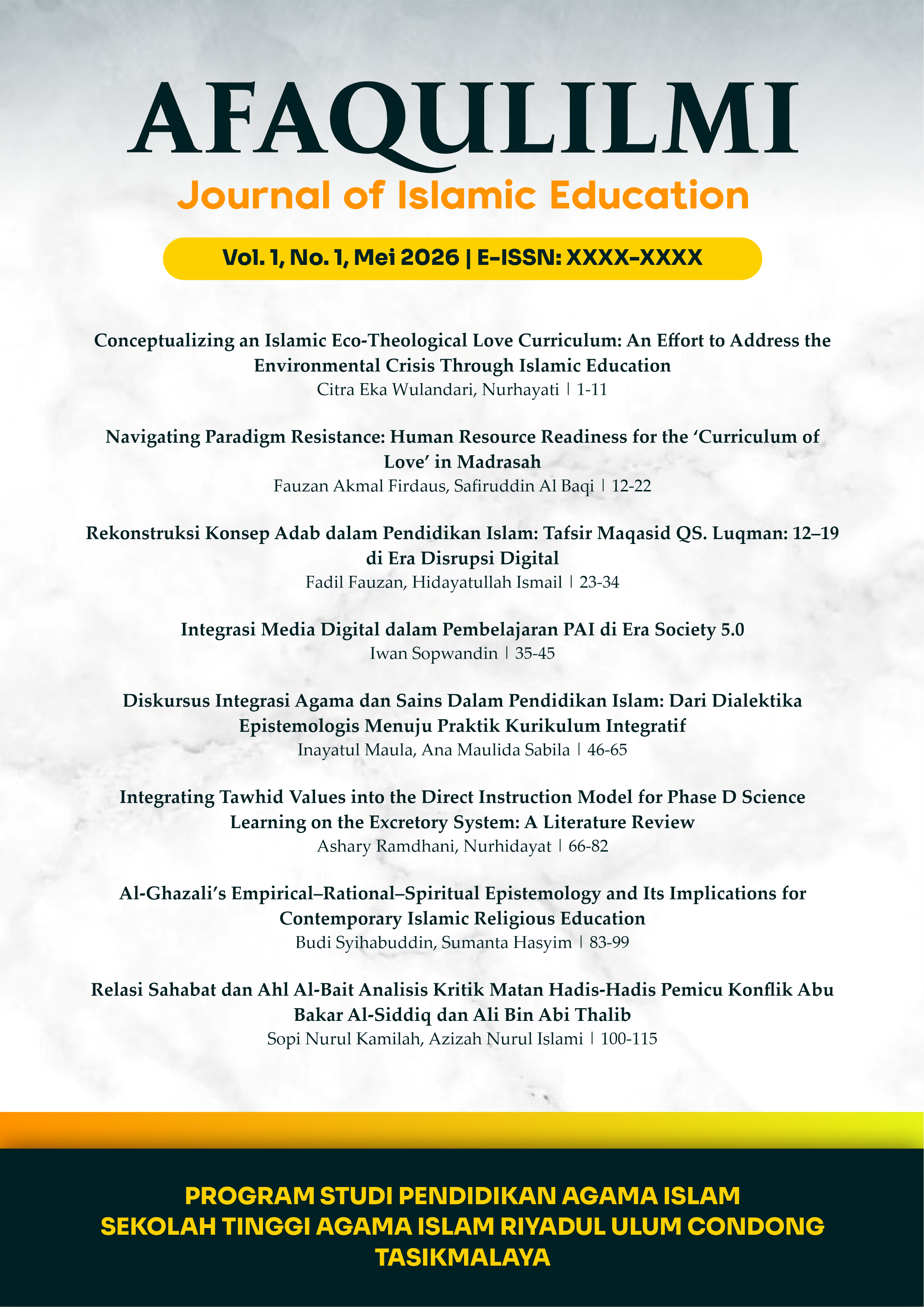
Rekonstruksi Konsep Adab dalam Pendidikan Islam: Tafsir Maqasid QS. Luqman: 12–19 di Era Disrupsi Digital
Keywords:
adab, tafsir maqāṣid, QS. Luqman, pendidikan Islam, etika digitalAbstract
Perkembangan teknologi digital telah membawa perubahan signifikan dalam pola interaksi manusia yang berdampak pada munculnya krisis etika di ruang digital, seperti penyebaran hoaks, ujaran kebencian, dan pelecehan verbal. Fenomena ini menunjukkan lemahnya internalisasi nilai dalam sistem pendidikan, khususnya terkait konsep adab dalam pendidikan Islam. Berdasarkan permasalahan tersebut, artikel ini bertujuan untuk merekonstruksi konsep adab melalui pendekatan tafsir maqāṣid terhadap QS. Luqman ayat 12–19 agar relevan dengan konteks era disrupsi digital. Penelitian ini menggunakan metode kualitatif dengan pendekatan kepustakaan (library research), serta analisis tafsir tematik yang dipadukan dengan perspektif maqāṣid al-syarī‘a. Hasil penelitian menunjukkan bahwa konsep adab dalam QS. Luqman ayat 12–19 merupakan sistem nilai yang integratif, meliputi orientasi ketuhanan, kesadaran diri, dan tanggung jawab sosial yang saling berkaitan. Melalui pendekatan maqāṣid, nilai-nilai tersebut dipandang sebagai tujuan syariat yang berfungsi menjaga keseimbangan kehidupan manusia. Rekonstruksi konsep adab dalam konteks digital menegaskan pentingnya pembentukan kesadaran internal sebagai dasar perilaku etis di tengah minimnya kontrol eksternal. konsep adab berbasis tafsir maqāṣid memiliki relevansi dan kontribusi signifikan dalam pengembangan pendidikan Islam yang dalam merespons krisis etika di era disrupsi digital.
References
Al-Ghazali, A. H. (2005). Al-Mustashfa min Ilm al-Usul. Dar al-Kutub al-Ilmiyyah. https://archive.org/details/al-mustashfa
Al-Shatibi, I. ibn M. (1997). Al-Muwafaqat fi Usul al-Shariah. Dar al-Ma’rifah. https://archive.org/details/al-muwafaqat
Auda, J. (2022). Re-envisioning Islamic Scholarship: Maqasid Methodology. International Institute of Islamic Thought. https://books.google.com/books?id=SmFjEAAAQBAJ
Aziz, S., & Ma’arif, M. J. (2025). Ulama Regeneration through Tafaqquh fi al-Din in Pesantren Education. Journal of Pesantren Studies. http://ejournal.lppdjatim.org/index.php/jpds/article/view/44
Basid, A., & Jazila, S. (2023). Tinjauan Konsep Mubadalah dan Tafsir Maqashidi dalam Merespon Isu Kekerasan Seksual. Islamic Review: Jurnal Riset Dan Kajian Keislaman, 12(1), 117–132. https://doi.org/10.35878/islamicreview.v12i1.722
Charits, A. (2025). Relevansi Maqashid Syariah dalam Konsep Pendidikan Islam. AlMaheer: Jurnal Pendidikan Islam, 3(01), 9–15. https://doi.org/10.63018/jpi.v3i01.137
Elihami, S. P. (2025). Muslim 5.0: Smart Islamic Education in the Age of Artificial Intelligence. Global Publisher. https://books.google.com/books?id=QPF_EQAAQBAJ
Faisal, A. I. A. A. B. (2020). Membangun Nilai-Nilai Peradaban Bangsa Dengan Pendidikan Karakter. Eduprof : Islamic Education Journal, 2 (2)(2). https://d1wqtxts1xzle7.cloudfront.net/105798615/185_Research_Results_776_1_10_20230421_3_-libre.pdf?1695051594=&response-content-disposition=inline%3B+filename%3DMembangun_Nilai_Nilai_Peradaban_Bangsa_d.pdf&Expires=1734201756&Signature=T9tKZbisyMF8l~99F62
Hakim, L., Ubaidillah, I., & Bulqini, B. (2024). Nilai-Nilai Pendidikan Karakter dalam Perspektif Al-Qur’an. Jurnal Ilmu Al-Qur’an Dan Tafsir. https://stiqwalisongo.ac.id/ejournal/index.php/Qolam/article/view/768
Hanum, L., Asma, N., & Khairiah, S. (2025). Institutionalizing Kindness in Islamic Education. Al-Ishlah Journal. http://www.journal.staihubbulwathan.id/index.php/alishlah/article/view/8275
Hussin, S. B. H. (2025). Islamic Digital Civilisation: Challenges and Ethical Values. International Journal of Islamic Thought. https://e-jurnal.yadim.com.my/index.php/jurnal-yadim/article/view/345
Ibn Ashur, M. al-T. (2006). Maqasid al-Shariah al-Islamiyyah. Dar al-Salam. https://archive.org/details/maqasid-ibn-ashur
Ibn Kathir, I. ibn U. (2003). Tafsir al-Qur’an al-’Azim. Dar Tayyibah. https://archive.org/details/tafsir-ibn-kathir
Irmayanti, A. P., Zulheldi, Z., Samad, D., Syamsi, S., & Maulana, F. (2024). Urgensi Hukum Islam dan Maqashid Syari’ah dalam Pendidikan Agama Islam. Ta Dib Jurnal Pendidikan Islam, 13(1), 59–68. https://doi.org/10.29313/tjpi.v13i1.13289
Lerma-mayer, A. (2024). Understanding Dialogic Relationships in Digital Science Communication. Springer Nature Singapore. https://doi.org/10.1007/978-981-96-1289-5
Memon, N. A. (2026). Integrating Digital Pedagogy and Islamic Values. International Journal of Islamic Education. https://journal.eduglobal.ac.id/index.php/ijire/article/view/3
Parapat, A. A. (2024). Konsep Pendidikan Anak dalam Perspektif Islam Era 4.0. http://etd.uinsyahada.ac.id/id/eprint/11466
Pendidikan Adab Menurut Syed Muhammad Naquib al-Attas. (2022). Wikipedia Akademik. https://id.wikipedia.org/wiki/Pendidikan_Adab_Menurut_Syed_Muhammad_Naquib_al-Attas
Prawira, A. E. (2026). Kasus FH UI: Komnas Perempuan Desak Dugaan Pelecehan Seksual Diproses Secara Hukum. Liputan6. iputan6.com/health/read/6317045/kasus-fh-ui-komnas-perempuan-desak-dugaan-pelecehan-seksual-diproses-secara-hukum
Rahmani, D. A., Muhayati, S., & Kholis, I. (2025). Analisis Data Kualitatif. 9, 13037–13048.
Rianto, M. I., Cahnia, D., & Baiti, N. (2025). Integration of Moral Values in Islamic Education. Adabiyah Journal. https://scholar.google.com
Rifa, A. (2025). Pendidikan Al-Qur ’ an dan Hadits : Membentuk Generasi Cerdas di Era Pendidikan Kontemporer. 03(01). https://doi.org/10.55352/edu.v3i1.1503
Sati, A., Halim, A., & Nasution, A. H. (2025a). The Digital Transformation of Tafsir and Its Implications. Metro Islamic Law Review. https://www.test.metrouniv.ac.id.ejournal.metrouniv.ac.id/index.php/milrev/article/view/10425
Sati, A., Halim, A., & Nasution, A. H. (2025b). The Digital Transformation of Tafsir and Its Implications in Contemporary Era. Metro Islamic Law Review. https://ejournal.metrouniv.ac.id/index.php/milrev/article/view/10425
Shihab, M. Q. (2002). Tafsir Al-Mishbah. Lentera Hati. https://repository.uinjkt.ac.id/dspace/handle/123456789/22624
Sudrajat, U., Basuki, I. S. S., Biantoro, S., Setiawan, B., & Mulyadi. (2021). Penguatan Kesadaran Sejarah Siswamelalui Sejarah Lokal dan PelibatanKomunitas Sejarah. Risalah Kebijakan , 16.
Suhita, B. M., Ratih, N., & Priyanto, K. E. (2021). Psychological Impact On Victims of Sexual Violence : Literature Review. 10(1), 1412–1423. https://doi.org/10.30994/sjik.v10i1.825
Zain, M., & Ilyasin, M. (2014). Islamic Education and Maqasid Approach. In AICIS Conference Proceedings. https://digilib.uin-suka.ac.id/id/eprint/17126/
Downloads
Published
Issue
Section
License
Copyright (c) 2026 Fadil Fauzan, Hidayatullah Ismail (Author)

This work is licensed under a Creative Commons Attribution-ShareAlike 4.0 International License.

This work is licensed under a Creative Commons Attribution-ShareAlike 4.0 International License.
You are free to:
- Share — copy and redistribute the material in any medium or format for any purpose, even commercially.
- Adapt — remix, transform, and build upon the material for any purpose, even commercially.
- The licensor cannot revoke these freedoms as long as you follow the license terms.
Under the following terms:
- Attribution — You must give appropriate credit , provide a link to the license, and indicate if changes were made . You may do so in any reasonable manner, but not in any way that suggests the licensor endorses you or your use.
- ShareAlike — If you remix, transform, or build upon the material, you must distribute your contributions under the same license as the original.
- No additional restrictions — You may not apply legal terms or technological measures that legally restrict others from doing anything the license permits.
Notices:
You do not have to comply with the license for elements of the material in the public domain or where your use is permitted by an applicable exception or limitation .
No warranties are given. The license may not give you all of the permissions necessary for your intended use. For example, other rights such as publicity, privacy, or moral rights may limit how you use the material.


