
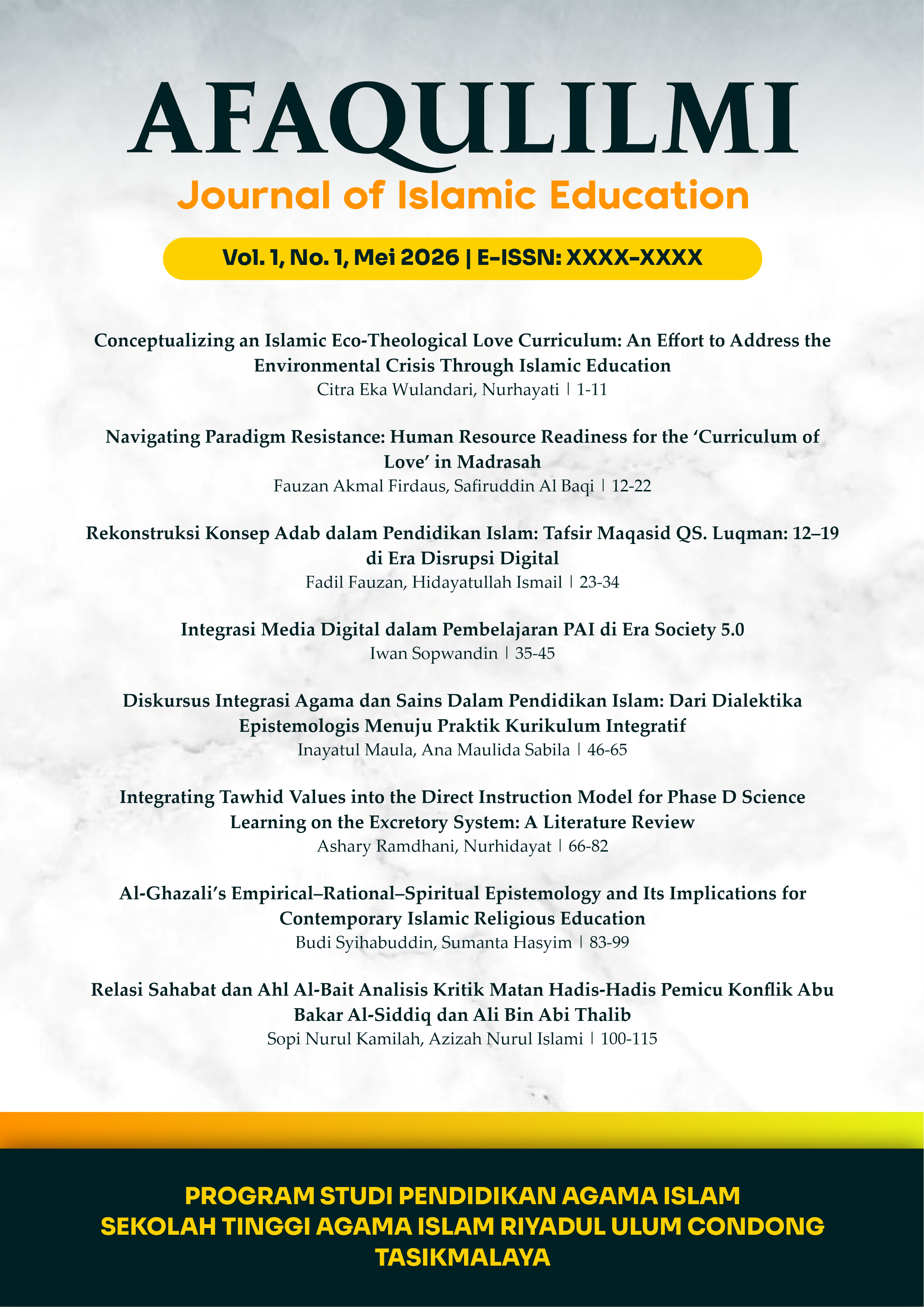
Integrating Tawhid Values into the Direct Instruction Model for Phase D Science Learning on the Excretory System: A Literature Review
Keywords:
Excretory System, Engineering Design Process, Islamic Science Education, Tawhid Integration, STEM EducationAbstract
The secularization of science education frequently creates an epistemological dichotomy, alienating learners from their spiritual identity. This study aims to synthesize a conceptual instructional design that integrates Islamic Tawhid values, specifically Ash’arite theology, into the learning of the human excretory system. Utilizing a qualitative library research approach, interdisciplinary literature encompassing biological curricula and thematic Qur’anic exegesis was examined using content analysis and an interactive qualitative model. The findings reveal a profound ontological mapping where excretory organs reflect divine balance and the absolute power of God, refuting independent mechanistic causality. To operationalize these concepts, a Tawhid-integrated engineering design process syntax was developed. By guiding students to design and test artificial filtration prototypes, this framework transforms technical problem-solving into an act of worship and earthly stewardship. This structured pedagogical approach successfully preserves rigorous scientific integrity, prevents dogmatic pseudoscience, and significantly enhances students’ analytical resilience. Ultimately, this integrated engineering model transforms passive learners into ethically grounded innovators, providing a highly robust pedagogical blueprint that advances holistic character development in contemporary Islamic science education.
References
A’yun, Q., Azizah, N., & Rahman, A. (2025). Islamic education curriculum development approach in the digital era: Integration of tauhid values and contextual adaptation. Andragogi: Jurnal Pendidikan Islam dan Manajemen, 5(2), 214–225.
Akbar, M., Saputro, S., & Masykuri, M. (2025). Internalisasi Profil Pelajar Rahmatan Lil Alamin dalam kurikulum madrasah terpadu. Jurnal Pendidikan Karakter, 12(1), 45–58.
Akbar, Z., Rahman, F., & Hidayat, T. (2023). Konsep Halalan Thayyiban dan korelasinya terhadap homeostasis tubuh manusia. Journal of Islamic Medicine and Health Sciences, 4(2), 112–125.
Amin, A. M., Ibrahim, M., & Alkusaeri, A. (2022). Penerapan kerangka kerja STEM dan Engineering Design Process untuk meningkatkan keterampilan abad 21. Jurnal Pendidikan Sains Indonesia, 10(3), 415–430.
Darmana, A. (2012). Epistemologi sains Islam dan tantangan pseudosains di ruang kelas. Jurnal Filsafat dan Pemikiran Islam, 8(2), 89–104.
Fajar Shodiq, M. (2023). Merdeka curriculum in Islamic schools: Bridging global competence and local wisdom. Indonesian Journal of Islamic Education Studies, 6(1), 77–92.
Harahap, A. (2018). Integrasi Al-Qur’an dan materi pembelajaran kurikulum sains pada tingkat sekolah di Indonesia: Langkah menuju kurikulum sains berbasis Al-Qur’an. Jurnal Penelitian Medan Agama, 9(1), 23–38.
Hasan, M. (2020). Kendala epistemologis dan praktis dalam Islamisasi pengetahuan di pendidikan menengah. Ta’dib: Journal of Islamic Education, 25(1), 55–70.
Imamah, N. (2025). Kajian literatur sistematis: Integrasi nilai-nilai sains dan agama dalam pendidikan STEM. Journal of Natural Science and Integration, 6(1), 12–28.
Jamaluddin, J., Syarifah, S., & Misbah, M. (2025). Conceptualizing the Islamic worldview in biology education: A critical-comparative analysis. International Journal of Islamic Science Education, 3(2), 144–160.
Jolly, A. (2016). STEM by design: Strategies and activities for grades 4-8. Routledge.
Judijanto, L., & Yusniar, Y. (2025). The impact of Islamic values in STEM education on students’ moral sensitivity and motivation. Journal of Ethical Engineering Education, 11(1), 88–102.
Kitchenham, B., & Brereton, P. (2013). A systematic review of systematic review process research in software engineering. Information and Software Technology, 55(12), 2049–2075. https://doi.org/10.1016/j.infsof.2013.07.010
Muslim, M. (2024). Moral sensitivity in biology education: Integrating Qur’anic ecology. Jurnal Pendidikan Biologi Islami, 9(2), 210–225.
Nasr, S. H. (1993). The need for a sacred science. Curzon Press.
Noor, M. (2017). Implementasi gagasan Islamisasi sains Al-Attas dan Al-Faruqi dalam kurikulum modern. Islamika: Jurnal Ilmu-Ilmu Keislaman, 17(2), 134–150.
Nurlinda, N. (2024). Penerapan Project-Based Learning dalam pembelajaran sains untuk menumbuhkan akhlakul karimah. ISLAMIKA, 7(1), 67–78.
Nurmela, S., Restu, Y. M., Sari, M. S., Badrudin, B., & Zaqiah, Q. Y. (2025). Integrasi Profil Pelajar Rahmatan Lil Alamin pada kurikulum madrasah Aliyah. AL-AFKAR: Journal for Islamic Studies, 8(1), 1349–1365.
Page, M. J., McKenzie, J. E., Bossuyt, P. M., Boutron, I., Hoffmann, T. C., Mulrow, C. D., ... & Moher, D. (2021). The PRISMA 2020 statement: An updated guideline for reporting systematic reviews. Systematic Reviews, 10(1), 1–11.
Palangi, A., Rahmat, H., & Suryani, E. (2025). Pengaruh model Project Based Learning berbasis STEM terhadap keterampilan berpikir kreatif siswa. Indonesian Journal of Innovation Multidisciplinary Research, 4(2), 1056–1065.
Pratama, R., Hidayat, A., & Fauzi, M. (2024). Tafsir ilmi dan anatomi: Menggali makna reseptor kulit dalam QS. An-Nisa ayat 56. Jurnal Studi Al-Qur’an dan Sains, 11(2), 201–215.
Purwaningsih, E., Suyatno, S., & Wasis, W. (2021). Efektivitas sintaks Engineering Design Process (EDP) pada pembelajaran sains Fase D. Jurnal Inovasi Pendidikan Sains, 12(1), 45–59.
Putra, R. S., & Maheswara, D. (2024). Peningkatan sensitivitas etis dan karakter inovator Muslim melalui STEM terintegrasi agama. Journal of Islamic Science and Technology Education, 5(3), 312–328.
Ramadhani, R., & Hardianti, H. (2025). Building students’ creative thinking skills in science learning: A systematic review of STEM-based approaches. Journal of Science Education Research, 14(1), 89–105.
Sari, R., & Asmendri, A. (2020). Penelitian kepustakaan (library research) dalam penelitian pendidikan IPA. Natural Science: Jurnal Penelitian Bidang IPA dan Pendidikan IPA, 6(1), 41–53.
Siregar, M. (2024). Analisis data kualitatif dalam riset pendidikan Islam. Pustaka Pelajar.
Sugiyono. (2023). Metode penelitian kuantitatif, kualitatif, dan R&D. Alfabeta.
Susanti, E., Kusen, K., & Sumarto, S. (2024). Strategi pedagogis pembentukan karakter di sekolah Islam: Mengatasi degradasi moral. Assyfa International Research Journal, 2(1), 107–120.
Syarifah, L., & Misbah, M. (2024). Dampak dikotomi sains sekuler terhadap krisis epistemologis siswa Muslim. Jurnal Filsafat Pendidikan Islam, 10(1), 77–93.
Tanjung, I. F., Azhari, N. S., & Akhyar, S. (2026). Maintaining epistemological integrity in integrating science and religion in biology modules. Journal of Biological Education and Science, 8(1), 44–60.
Ulum, M., Putra, A., & Nuraini, N. (2021). The role of Engineering Design Process in K-12 science problem solving. International Journal of STEM Education, 8(4), 112–128.
Wan Daud, W. M. N. (2010). Filsafat dan praktik pendidikan Islam Syed M. Naquib Al-Attas. Mizan.
Yahyan, A., & Madkur, M. (2017). Adaptasi dan purifikasi kurikulum sains modern: Sebuah tinjauan Islamisasi pengetahuan. Jurnal Pendidikan Islam, 12(2), 210–225.
Zabidi, A., Mohamad, Z., & Jamaludin, H. (2019). Menghindari pseudosains dalam pendidikan integratif: Pentingnya kerangka sains Islam yang kokoh. Journal of Islamic Science and Epistemology, 5(2), 134–149.
Zainal, A. (2021). Tantangan dan peluang guru IPA dalam mengintegrasikan nilai agama. Golden Ratio Journal of Education, 3(1), 45–60.
Zarman, W. (2021). Pendidikan IPA berlandaskan nilai keimanan: Konsep dan model penerapannya. Deepublish.
Zubaidah, S., Mahanal, S., Yulianti, L., Dasna, I. W., Pangestuti, A. A., & Puspitasari, D. R. (2017). Buku ilmu pengetahuan alam SMP/MTs Kelas VIII. Kementerian Pendidikan dan Kebudayaan Republik Indonesia.
Downloads
Published
Issue
Section
License
Copyright (c) 2026 Ashary Ramdhani, Nurhidayat (Author)

This work is licensed under a Creative Commons Attribution-ShareAlike 4.0 International License.

This work is licensed under a Creative Commons Attribution-ShareAlike 4.0 International License.
You are free to:
- Share — copy and redistribute the material in any medium or format for any purpose, even commercially.
- Adapt — remix, transform, and build upon the material for any purpose, even commercially.
- The licensor cannot revoke these freedoms as long as you follow the license terms.
Under the following terms:
- Attribution — You must give appropriate credit , provide a link to the license, and indicate if changes were made . You may do so in any reasonable manner, but not in any way that suggests the licensor endorses you or your use.
- ShareAlike — If you remix, transform, or build upon the material, you must distribute your contributions under the same license as the original.
- No additional restrictions — You may not apply legal terms or technological measures that legally restrict others from doing anything the license permits.
Notices:
You do not have to comply with the license for elements of the material in the public domain or where your use is permitted by an applicable exception or limitation .
No warranties are given. The license may not give you all of the permissions necessary for your intended use. For example, other rights such as publicity, privacy, or moral rights may limit how you use the material.


