
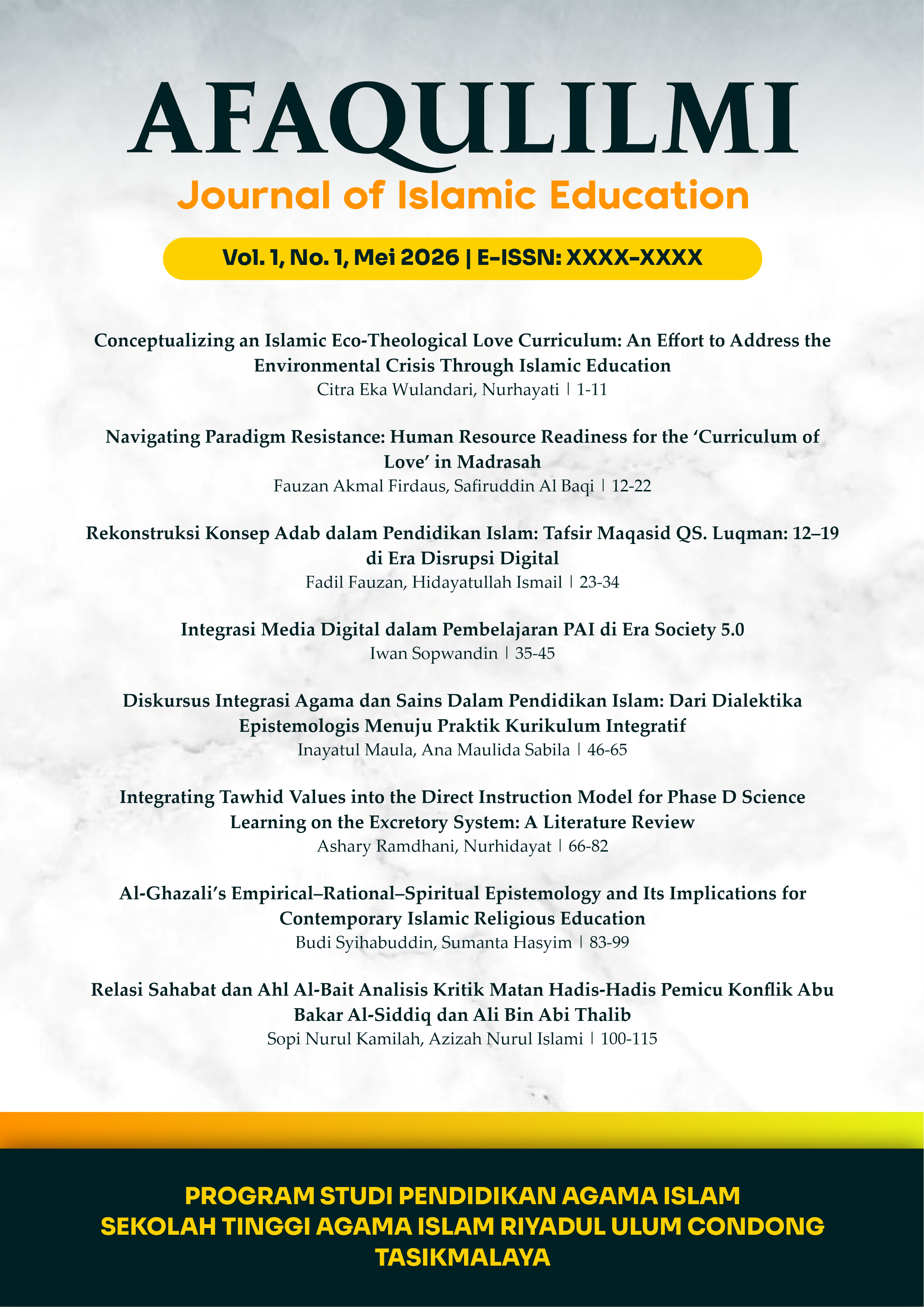
Conceptualizing an Islamic Eco-Theological Love Curriculum: An Effort to Address the Environmental Crisis Through Islamic Education
Keywords:
Curriculum of Love, Islamic Ecotheology, Islamic Education, Environmental CrisisAbstract
The current global environmental crisis is rooted in anthropocentric views and a lack of spiritual awareness, which, ironically, is exacerbated by an Islamic Religious Education (IRE) approach that remains rigid and fiqh-centric. This study aims to formulate a conceptual framework for an “Ecological Love Curriculum” grounded in Islamic eco-theology as a resolution to the ecological crisis through spiritual and affective transformation in the classroom. The method employed is qualitative library research using content analysis and thematic discourse analysis of literature in theology, Sufism, and pedagogy. The findings reveal that the concept of mahabbah (love) must expand into universal love for the universe as a tajalli (manifestation) of God’s majesty. Practically, this curriculum is implemented through holistic pedagogical transformations, such as Project-Based Learning focused on ecosystem conservation, reflective nature contemplation methods, and the application of an eschatological carbon footprint journal to instill an ethic of care. As concrete recommendations, policymakers and educational institutions are urged to adopt this framework into the official PAI syllabus, and further Classroom Action Research (PTK) is needed to test its empirical effectiveness.
References
Anwar, S., Maulani, F., Lutfiah, W., Syadiah, S. I. H., & Azizah, A. S. N. (2027). Integrasi Nilai Ketauhidan dan Ekopedagogi dalam Kurikulum Madrasah Ibtidaiyah untuk Penguatan Karakter Peduli Lingkungan. TSAQAFATUNA : Jurnal Ilmu Pendidikan Islam, 7(1), 112–129. https://doi.org/10.54213/tsaqafatuna.v7i1.611
Azhari, H., Ropitasari, A., Mu’min, U., Khutomi, B., & Bakar, A. (2025). The Role of Green Islamic Education in Developing Eco-Theological Consciousness Among Emerging Muslim Generations. EDUKASI: Jurnal Penelitian Pendidikan Agama Dan Keagamaan, 23(3), 531–542. https://doi.org/10.32729/edukasi.v23i3.2374
Azizah, W., Luthfi, E., Ahsani, F., Guru, P., Ibtidaiyah, M., Islam, U., Sunan, N., Conge, J., & Tengah, J. (2026). Integrasi Nilai Ekoteologi untuk Menumbuhkan Kesadaran Life on Land dalam Pembelajaran IPAS di MI Darul Ulum 02. Indonesian Journal of Elementary Education and Teaching Innovation, 5(1), 33–50. https://doi.org/10.21927/ijeeti.2026.5(1).33-50
Bahri, A. S., Napsin, N., Abidin, Z., Komara, D., & Maryati, N. (2025). Ecological Piety: A Qur’anic Conceptual Review of Green Islamic Character Education. Indonesian Values and Character Education Journal, 8(1), 60–83. https://doi.org/10.23887/ivcej.v8i1.94409
Bransika, D. M. I., Iswantir, I., Wati, S., Husni, A., & Zakir, S. (2025). Problematika Pendidikan Agama Islam di Universitas Merangin. TEACHING : Jurnal Inovasi Keguruan Dan Ilmu Pendidikan, 5(2), 254–263. https://doi.org/10.51878/teaching.v5i2.6213
Budi Prakoso, S. (2025). Ecotheology Education in Indonesian High School based on Quranic Perspective and University Courses. LECTURES: Journal of Islamic and Education Studies, 4(3), 419–436. https://doi.org/10.58355/lectures.v4i3.174
Dirzo, R., Ceballos, G., & Ehrlich, P. R. (2022). Circling the drain: the extinction crisis and the future of humanity. Philosophical Transactions of the Royal Society B: Biological Sciences, 377(1857), 20210378. https://doi.org/10.1098/rstb.2021.0378
Febrianingsih, D., Arifi, A., & Sabarudin, S. (2025). Ecotheology as a New Direction in the Politics and Policy of Islamic Religious Education in Indonesia. QALAMUNA: Jurnal Pendidikan, Sosial, Dan Agama, 17(2), 1455–1468. https://doi.org/10.37680/qalamuna.v17i2.7426
Firdaus, F. A. (2024). Membangun Kesadaran Lingkungan Melalui Kurikulum Pendidikan Islam Kontribusi terhadap SDGs. TarbiyahMU, 4(2), 13–21.
Fletcher, C., Ripple, W. J., Newsome, T., Barnard, P., Beamer, K., Behl, A., Bowen, J., Cooney, M., Crist, E., Field, C., Hiser, K., Karl, D. M., King, D. A., Mann, M. E., McGregor, D. P., Mora, C., Oreskes, N., & Wilson, M. (2024). Earth at risk: An urgent call to end the age of destruction and forge a just and sustainable future. PNAS Nexus, 3(4), pgae106. https://doi.org/10.1093/pnasnexus/pgae106
Jumaah, J., Saparudin, S., & Nuruddin, N. (2026). Eco-Theology–Based Deep Learning as a Paradigm for Environmentally Conscious Islamic Religious Education Learning. Jurnal Inovasi Pendidikan Dan Sains, 7(1), 81–86. https://doi.org/10.51673/jips.v7i1.2753
Khomsinnudin, K., Pangeran, G. B., Tamyiz, A., Wulandari, C. E., & Firdaus, F. A. (2024). Modernitas dan Lokalitas: Membangun Pendidikan Islam Berkelanjutan. Journal of Education Research, 5(4), 4418–4428. https://doi.org/10.37985/jer.v5i4.1523
Masturin. (2022). Tawhid-Based Green Learning in Islamic Higher Education: An Insan Kamil Character Building. Qudus International Journal of Islamic Studies (QIJIS), 10(1), 215–252. https://doi.org/10.21043/qijis.v10i1.14124
Mustofah, M., & Dwi Agustin, Y. (2025). Relevansi Pemikiran Ekosufisme Abdul Karim Al-Jilli pada Gerakan Ekoteologi Di Indonesia. Spiritualita, 9(1), 77–91. https://doi.org/10.30762/spiritualita.v9i1.2893
Prasetyo, S. (2025). Integrating Ecotheology and Participatory Learning to Foster Students ’ Ecological Awareness. J-PAI: Jurnal Pendidikan Agama Islam, 12(1), 115–124.
Rifqi, M. I., & Saputra, A. (2025). Love-Based Curriculum: Fostering Islamic Eco-theology Education in Madrasah: Fostering Islamic Eco-theology Education in Madrasah. Ta’dibuna: Jurnal Pendidikan Islam, 14(5), 536–553. https://doi.org/10.32832/tadibuna.v14i5.21104
Rohman, A., Kurniawan, E., Syifauddin, M., Muhtamiroh, S., & Muthohar, A. (2024). Religious Education For The Environment: Integrating Eco-Theology In The Curriculum of Islamic Religious And Character Education To Enhance Environmental Education In Indonesia. Nadwa: Jurnal Pendidikan Islam, 18(2), 201–226. https://doi.org/10.21580/nw.2024.18.2.21094
Sakdiah, L., Nasri, U., Gani, S., Halim, A., & Dinika, E. (2025). Religious Education and Eco-Theology: Reorienting Spirituality toward the Ecological Crisis. Jurnal Inovasi Pendidikan Dan Sains, 6(3), 605-610. https://doi.org/10.51673/jips.v6i3.2696
Shahida. (2023). Green Academia: Integrating Islamic Teachings in Education for a Sustainable Future. Journal of Islamic Thought and Civilization, 13(2), 86–103. https://doi.org/10.32350/jitc.132.06
Shefer-Mossensohn, M. (2025). Modern Islamic Eco-Religion: Historical Contexts. Journal for the Study of Religion, Nature and Culture, 19(2), 237–264. https://doi.org/10.1558/jsrnc.27632
Suraijiah, S., Rusdiah, R., & Surawardi, S. (2026). Implementation of Environmental Education in the Concept of Ecotawhid and Ecotheology in Students. Kharisma: Jurnal Administrasi Dan Manajemen Pendidikan, 4(2), 232–245. https://doi.org/10.59373/kharisma.v4i2.113
Syafaruddin, B. (2025). Ecotheology in the Perspective of Islamic Education: A Conceptual Review. ETDC: Indonesian Journal of Research and Educational Review, 4(3), 720–731. https://doi.org/10.51574/ijrer.v4i3.3253
Downloads
Published
Issue
Section
License
Copyright (c) 2026 Citra Eka Wulandari, Nurhayati (Author)

This work is licensed under a Creative Commons Attribution-ShareAlike 4.0 International License.

This work is licensed under a Creative Commons Attribution-ShareAlike 4.0 International License.
You are free to:
- Share — copy and redistribute the material in any medium or format for any purpose, even commercially.
- Adapt — remix, transform, and build upon the material for any purpose, even commercially.
- The licensor cannot revoke these freedoms as long as you follow the license terms.
Under the following terms:
- Attribution — You must give appropriate credit , provide a link to the license, and indicate if changes were made . You may do so in any reasonable manner, but not in any way that suggests the licensor endorses you or your use.
- ShareAlike — If you remix, transform, or build upon the material, you must distribute your contributions under the same license as the original.
- No additional restrictions — You may not apply legal terms or technological measures that legally restrict others from doing anything the license permits.
Notices:
You do not have to comply with the license for elements of the material in the public domain or where your use is permitted by an applicable exception or limitation .
No warranties are given. The license may not give you all of the permissions necessary for your intended use. For example, other rights such as publicity, privacy, or moral rights may limit how you use the material.


